History Activities
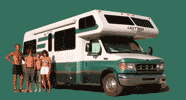
Showing 24 history activities logged during our motorhome cross-country adventures.
Cottage City
The hidden city within Oak Bluffs. In the summer in 1835 Methodists began coming to the island to hold religious revival meetings. They pitched their tents under a large grove of oaks in what is now Trinity Park and established the Martha’s Vineyard Camp Meeting. Gradually these tents were replaced with small Victorian-style cottages, which became known as “Gingerbread Cottages” because of their fanciful bright colors and ornate moldings. By 1880, 315 cottages had been built in a circular pattern around the original meeting area. A permanent structure called the Tabernacle, with seating for over 3,000 people, was built in the center to allow camp meetings to take place regardless of the weather. The town was incorporated as Cottage City.
Christiantown Memorial
Site of the Mayhew Chapel and a small Indian burial ground. Christiantown was established in 1659 as the first Christian Native American village. The chapel that stands there today was built in 1829. Inside there is a tiny altar and six pews
Edgartown
Edgartown was first settled by Europeans in 1642 for the purpose of converting the Wampanoag Indians on the island to Christianity. Fortunately, unlike many examples of disastrous cultural clashes in the history of European settlements in North America, the relationship between the English settlers, under the leadership of the Reverend Thomas Mayhew, Jr., and the Wampanoags of Martha’s Vineyard was a peaceful one, characterized by mutual respect. In the 1800s, Edgartowns “Great Harbor” helped to make it one of the most important whaling ports on the East Coast. Its numerous stately “Captain’s Houses” are reminders of that past period in its history.
Canby Cross
Memorial to General Canby, who during a peace gathering with the Modoc Indians, was shot in the face and killed by Captain Jack of the Modoc
Cabrillo National Monument
Site where the first European, Juan Rodriguez Cabrillo, set foot on the West Coast of the United States in 1542. Other sights to see include the Old Point Lomo Lighthouse and Whale Overlook.
Rhyolite Ghost Town
Remnants of a mining town that sprung up in 1904, grew to a population of over 5,000 people, and then went bust by 1911. After 1920, Rhyolite became a tourist attraction and a setting for motion pictures. Today visitors can see several remnants of the town’s glory days: the railway depot, the Bottle House, and the ruins of the 3 story bank and old jail
Rhyolite Ghost Town
Remnants of a mining town that sprung up in 1904, grew to a population of over 5,000 people, and then went bust by 1911. After 1920, Rhyolite became a tourist attraction and a setting for motion pictures. Today visitors can see several remnants of the town’s glory days: the railway depot, the Bottle House, and the ruins of the 3 story bank and old jail
Penny Can
At Mile 41.4, we came to the famous “penny can” hanging out by a wire from the limb of a Joshua tree. We dutifully stopped to add our pennies (which we had placed in the cupholder at home in anticipation of this moment) to the collection already in the can. As the Mojave Road was being developed into a recreational trail in 1983, this can appeared with a few pennies inside. Tradition then took over, and to this day travelers still stop to make their tongue-in-cheek contribution to Mojave Road maintenance.
Mailbox and Frog Garden
At mile 74.0, we came to the famous Mojave Road Mailbox, put there by the Friends of the Mojave Road in 1983. Inside the box is a book in which passing travelers are asked to sign, including information as to the number of people in their party, the date, and their impressions of their journey. A short distance behind the Mailbox is the less famous Frog Garden, where travelers leave frogs, of all shapes and sizes. We added our tiny rubber one to the mix.
Travelers Monument
Large pile of rocks on the western edge of the Soda Lake (mile 100.9). Every traveler that passes this way is encouraged to add a stone to the pile.
Calico Ghost Town
State Historical Landmark of a present-day ghost town, which was a thriving silver mining community in the 1880s. In the 1950s, Walter Knott purchased Calico and architecturally restored all but the five original buildings to look as they did in the 1880s.
Catavina Pinturas Rupestres (cave paintings)
The paintings are tucked inside a small cave at the top of a hill. They are fabulous - colorful yellow, red, and black geometric designs, abstract shapes, and a predominant sun, created by the Cochimi people about a 1,000 years ago.
Misión San Ignacio and Plaza
Sleepy colonial town nestled into a date palm oasis. Beautiful mission on the square and picturesque examples of colonial architecture.
Iglesia de Santa Barbara
Designed by Gustave Eiffel (of Eiffel Tower fame). Eiffel never actually came to Santa Rosalia. Back in 1884 while still in France, he designed a prefabricated metal church, made entirely of stamped steel sheet squares for easy portability, as a prototype for missionary churches in France’s tropical colonies. After being displayed at the 1889 Paris World's Exposition, where it won first prize for church design, it was stored in a Brussels warehouse and almost forgotten, until an official with the Boleo Mining Company learned of it and had it shipped to Santa Rosalia as a place for the miners to worship.
Museo Historico de Mulege
One-time prison turned into a museum. In its day, the prison was unique in its policy of allowing prisoners to leave during the day to work in town. 6 pm each evening, they were called back to their cells by the blowing of a conch cell. Today the museum houses an eclectic collection of historical artifacts.
Mision Santa Rosalia de Mulege
Founded in 1705 and built in 1766, this became the fourth mission in Baja. To visit this lovely stone church, follow Calle Zaragoza west up a slight hill.
Mision San Francisco Javier
Crown jewel of the Baja mission system because of its impressive architecture and excellent state of preservation. The lush gardens behind the mission have date palms, citrus, grapes, and olive trees, one of which is 315 years old. To drive to the mission is along a 24-mile, steep and winding road from Mexico 1, through the scenic valley of the Sierra de la Giganta to the tiny agricultural town of San Javier. The views of the craggy peaks of the Giganta along the way alone are worth the trip.
Mision Nuestra Senora de Loreto Concho
Founded in 1697, this was the first Spanish mission in California (both Alta and Baja). At that time Loreto was the religious center of California, so new missions were built out from here on a network of roads known as El Camino Real. Loreto’s primacy was clearly stated over the church portal, “Cabeza y Madre de las Misiones de Baja y Alta California” (“Head and mother of the Missions of Lower and Upper California”).
Aguereberry Mining Camp
Established by old-time prospector Shorty Harris and his greenhorn partner Pete Aguereberry in 1905 in order to mine the gold out of the hills behind it. The boom was rather short-lived, and when the mine’s output decreased, Shorty and the rest of the miners left. However, Pete Aguereberry remained, and worked the mine for some 40 more years until his death in 1945. The original cabin that he built and lived in is still on the site. The buildings in the front were built in the 1940's as guest houses.
Floreana Post Office
The Post Office's origin dates back to 1793, when whalers began the practice of leaving mail in a barrel for homeward-bound ships to collect and deliver to people back home. Today, the tradition is carried on by tourists, such as us.
Cottage City
The hidden city within Oak Bluffs. In the summer in 1835 Methodists began coming to the island to hold religious revival meetings. They pitched their tents under a large grove of oaks in what is now Trinity Park and established the Martha’s Vineyard Camp Meeting. Gradually these tents were replaced with small Victorian-style cottages, which became known as “Gingerbread Cottages” because of their fanciful bright colors and ornate moldings. By 1880, 315 cottages had been built in a circular pattern around the original meeting area. A permanent structure called the Tabernacle, with seating for over 3,000 people, was built in the center to allow camp meetings to take place regardless of the weather. The town was incorporated as Cottage City.
Edgartown
Edgartown was first settled by Europeans in 1642 for the purpose of converting the Wampanoag Indians on the island to Christianity. Fortunately, unlike many examples of disastrous cultural clashes in the history of European settlements in North America, the relationship between the English settlers, under the leadership of the Reverend Thomas Mayhew, Jr., and the Wampanoags of Martha’s Vineyard was a peaceful one, characterized by mutual respect.
Edgartown’s location on a perfect harbor helped it become one of the primary ports for the whaling industry during the 1800s, and more than 100 Edgartown men were captains of whaling ships. The profits from successful whaling voyages were enormous, as can be seen by the elegant mansions these captains built – clad in white-painted clapboard with black shutters, with wraparound porches and oftentimes widow’s walk atop the roof.
The thriving whaling industry came to an end in the late 1800s when oil and kerosene began replacing the need for whale oil.
Hildene
The magnificent former summer home of Robert Todd Lincoln, the only surviving son of President Abraham Lincoln. The home is perched on a promontory with breathtaking views of the Battenkill Valley, nestled between the Taconic and Green Mountains. Visitors can tour the meticulously preserved 24-room Georgian Revival mansion, which is furnished almost entirely with original Lincoln family furniture and personal belongings. The formal garden in front of the estate is designed to resemble a stained-glass cathedral window. The pattern is created with privet hedges, and the "panes" are filled with a vibrant mix of annual and perennial flowers.
Burning Man
Burning Man is an annual, week-long event focused on community, art, radical self-expression, and radical self-reliance. It takes place in a temporary city called Black Rock City, which is built by its participants in the Black Rock Desert of northwestern Nevada.